

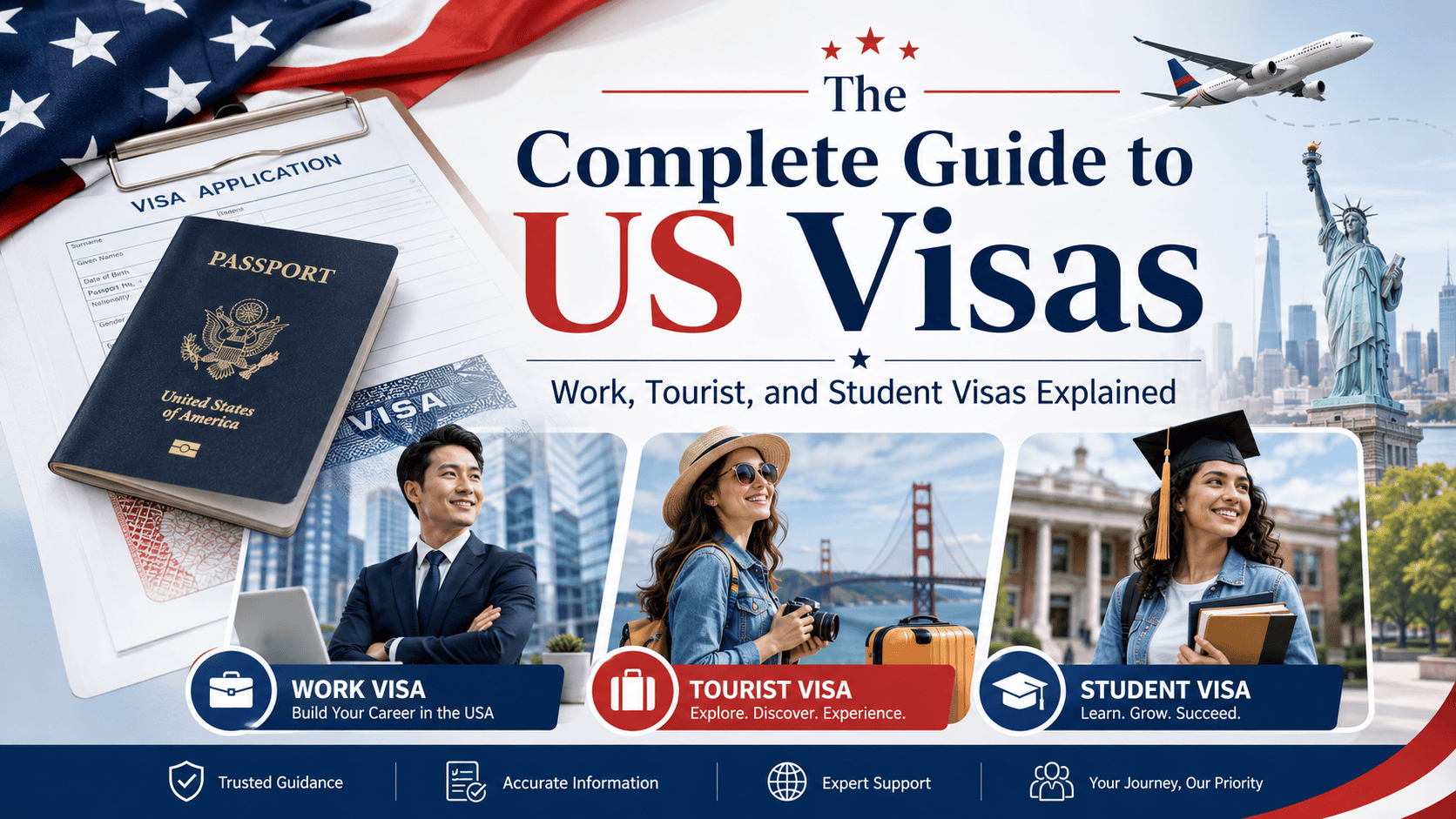
The Complete Guide to US Visas: Work, Tourist, and Student Visas Explained
Applying for a US visa can feel overwhelming. Between confusing government forms, shifting requirements, and long processing times, it’s easy to make a mistake that costs you weeks or even months of delay. Whether you’re planning a vacation, chasing a job opportunity, or starting a degree program in the United States, understanding the visa process before you apply is the single best thing you can do to avoid setbacks.
In this guide, we’ll break down the three most common US visa categories — tourist, work, and student — so you know exactly what to expect, what documents you’ll need, and where people most often go wrong.
Why the US Visa Process Feels So Complicated
The United States doesn’t have a single “visa” — it has dozens of visa categories, each with its own eligibility rules, forms, and supporting documents. On top of that, requirements can vary depending on:
- Your home country and any visa agreements it has with the US
- The specific US consulate or embassy processing your application
- Current USCIS and State Department processing backlogs
- Whether you’ve had any prior visa refusals or immigration violations
This is why two people applying for what seems like the “same” visa can have very different experiences. A little preparation — and knowing which category actually fits your situation — makes a big difference.
1. US Tourist Visa (B-2)
The B-2 visa is for people visiting the US for tourism, vacation, visiting family, or medical treatment. It’s often paired with the B-1 visa (for short business trips) into a combined B-1/B2 visa.
Basic Requirements
- A valid passport (typically valid for at least six months beyond your intended stay)
- A completed DS-160 online nonimmigrant visa application form
- A recent passport-style photo meeting US government specifications
- Proof of ties to your home country (job, property, family) showing you intend to return
- Evidence you can financially support your trip (bank statements, sponsor letters, etc.)
- A scheduled visa interview at a US embassy or consulate (for most applicants)
Common Mistakes
The most frequent reason for a B-2 denial isn’t paperwork — it’s failing to convince the consular officer that you intend to return home. Weak documentation of job stability, family ties, or financial means is the top cause of refusals under Section 214(b) of the Immigration and Nationality Act. Being vague or inconsistent during the interview can also raise red flags, even when the paperwork is solid.
Processing Time
Tourist visa interview wait times vary dramatically by country and season — anywhere from a few days to several months. Once approved, visa issuance itself is usually quick, but the interview appointment backlog is often the real bottleneck.
2. US Work Visas (H-1B, L-1, O-1, and More)
Work visas are more complex because eligibility depends on your profession, your employer, and sometimes annual government quotas.
H-1B (Specialty Occupation)
The H-1B is the most well-known US work visa, typically used for roles requiring specialized knowledge (engineering, IT, finance, medicine, etc.). Key points:
- Requires a US employer to sponsor you and file a petition on your behalf
- Subject to an annual cap and lottery system, with registration usually opening in March
- Requires at least a bachelor’s degree (or equivalent experience) related to the job
- Employer must file a Labor Condition Application (LCA) before the petition
L-1 (Intracompany Transferee)
If you work for a multinational company, the L-1 visa allows transfer to a US branch, subsidiary, or affiliate, provided you’ve worked for the company abroad for at least one continuous year within the last three.
O-1 (Extraordinary Ability)
For individuals with exceptional achievement in their field — sciences, arts, education, business, or athletics. Requires substantial documented evidence of recognition, such as awards, media coverage, or significant contributions to the field.
Common Mistakes
Work visa cases are frequently delayed or denied due to:
- Incomplete or inconsistent employment history documentation
- Job descriptions that don’t clearly meet the “specialty occupation” standard
- Missing prevailing wage or labor condition documentation
- Applying for the wrong visa category altogether
Because employer sponsorship is required for most work visas, timing your application with your employer’s HR and legal teams is critical — missing the H-1B registration window, for example, means waiting a full year for the next cycle.
3. US Student Visa (F-1)
The F-1 visa is for individuals enrolled in an academic program at a US school certified by the Student and Exchange Visitor Program (SEVP).
Basic Requirements
- Acceptance at a SEVP-certified school, with a Form I-20 issued by the institution
- Payment of the SEVIS I-901 fee before your visa interview
- Proof of sufficient funds to cover tuition and living expenses for at least the first year
- Evidence of strong ties to your home country and intent to return after your studies
- A completed DS-160 and a scheduled visa interview
Common Mistakes
Similar to the tourist visa, F-1 denials often come down to failing to demonstrate non-immigrant intent — meaning the officer isn’t convinced you plan to return home after finishing your studies. Underestimating the required proof of financial support is another frequent issue, since schools and consulates expect documentation covering tuition plus living costs, not just tuition alone.
After Approval
F-1 visa holders can generally work on-campus part-time during their studies and may qualify for Optional Practical Training (OPT) after graduation, allowing temporary work authorization related to their field of study.
General Tips That Apply to Every Visa Category
- Start early. Interview wait times and processing backlogs fluctuate, and rushing increases the odds of a mistake.
- Be consistent. Every document, form, and interview answer should tell the same story about your purpose of travel, finances, and ties to home.
- Don’t guess on forms. Errors on the DS-160 or petition forms are a common cause of delays and Requests for Evidence (RFEs).
- Keep copies of everything. You’ll often need the same documents again for renewals, status changes, or future applications.
- Know your category before you apply. Applying under the wrong visa type wastes time and can complicate future applications.
Final Thoughts
The US visa system rewards preparation. Whether you’re applying for a short vacation, a specialized job opportunity, or a degree program, the strongest applications are the ones built on complete, consistent, and well-organized documentation submitted well ahead of any deadlines.
If you’d rather not navigate the process alone, our team works with applicants across tourist, work, and student visa categories every day. We can help you identify the right visa category, prepare a complete application, and get ready for your interview with confidence.
Have questions about your specific situation? Reach out to our team for a consultation — we’re here to make your visa journey as fast and stress-free as possible.